
Solar Lead Return Rates: Two Years of Our Own Data (2026)
Stephen Burkhalter16 min read
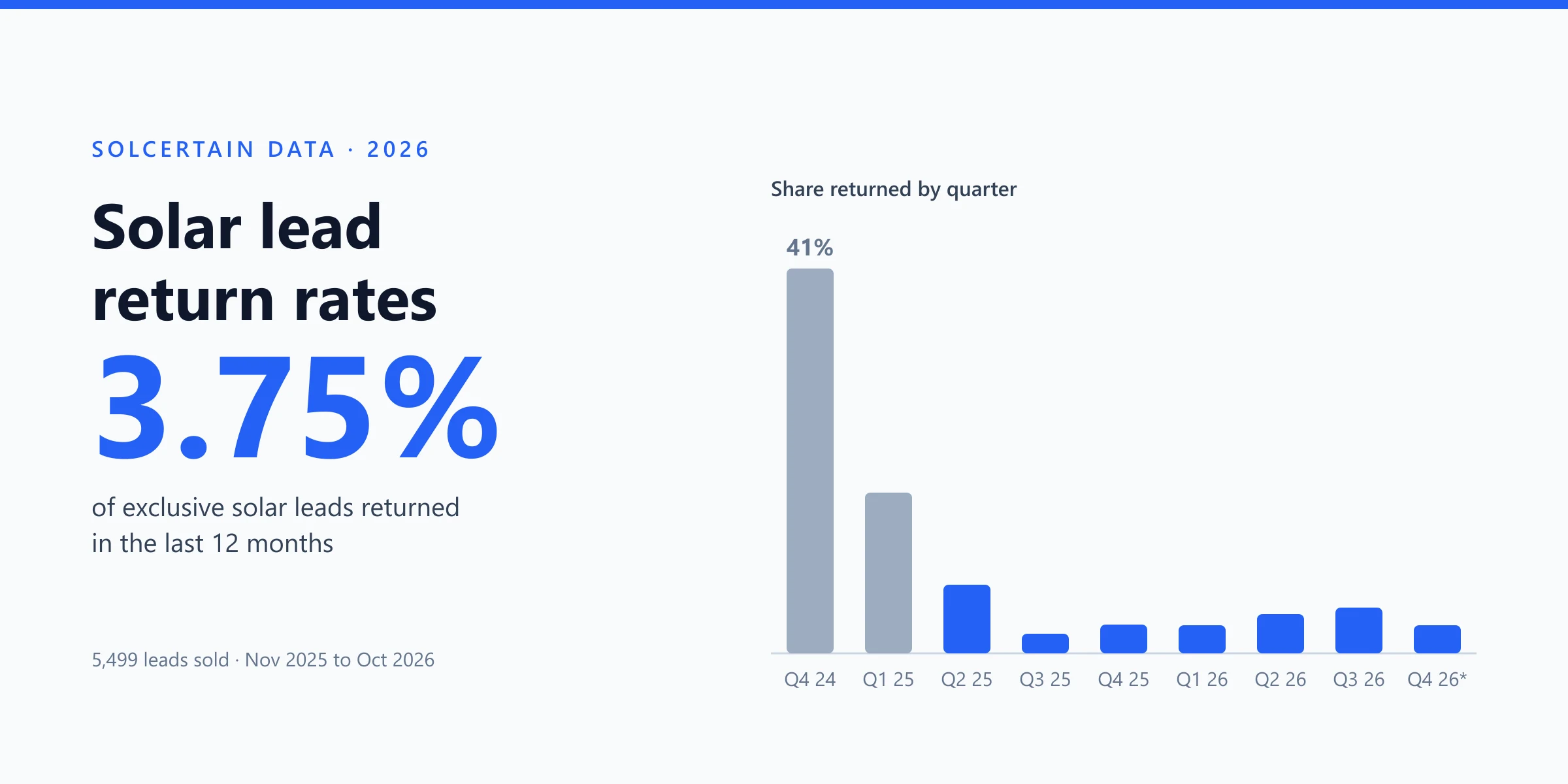
The one-line finding: Over the last 12 months, buyers returned 3.75% of the exclusive solar leads we sold (206 of 5,499), down from 41% in late 2024, when a fraudulent outside supplier was feeding the campaign, while quarterly volume grew more than tenfold.
Most lead sellers quote a quality claim and stop there. "Verified," "exclusive," "high-intent." None of those words tell a buyer what share of leads they will end up sending back. The return rate does, because it counts what buyers actually rejected under written criteria, not what the seller says about its own funnel.
This post publishes ours. It covers every exclusive solar lead we sold through our distribution platform over the last two years, broken down by quarter, with the caveats that come with the numbers.
Methodology
- Source. Campaign reports from the lead-distribution platform every Solcertain lead passes through. Each lead is logged when posted, when sold, and if a buyer's return request is approved.
- Scope. Our exclusive residential solar campaign, 13 November 2024 to 11 November 2026: 15,475 leads posted, 8,103 sold. The headline 12-month figures cover November 2025 to October 2026. The platform keeps two years of reporting, so nothing older is included.
- What we compare to. Our own earlier quarters. We have not found a published industry return-rate benchmark with a stated method we trust, so we do not quote one.
- How a return is counted. A return counts when a buyer asks for one within seven days under the published criteria and we approve it. Requests we decline are not counted.
- Download the data. The monthly figures behind every chart are in solar-lead-return-rates-2024-2026.csv (CC BY 4.0, credit Solcertain).
- What this is not. It is not a close rate, a contact rate or a guarantee. Return rates depend on buyer behaviour as much as on lead quality, and the early quarters rest on small numbers of leads.
Summary: the return rate at a glance
| Metric | Late 2024 to Q1 2025 | Last 12 months | Direction |
|---|---|---|---|
| Exclusive solar leads sold | 197 | 5,499 | More is more |
| Leads returned | 48 | 206 | |
| Return rate | 24.4% | 3.75% | Lower is better |
| Share of sold leads kept | 75.6% | 96.3% | Higher is better |
Across every campaign we ran over the full two years, including roofing, home improvement and aged-lead resale, buyers returned 504 of 11,796 sold leads: 4.3%.
Finding 1: Returns fell from 41% to under 5% a quarter
In the last two months of 2024 we sold 58 exclusive solar leads and buyers returned 24 of them. In the first quarter of 2025 the rate was 17%. Since July 2025, no full quarter has gone above 4.9%.
What happened in late 2024
The high early returns had a specific cause. From November 2024 to March 2025 we partnered with an outside lead supplier whose leads, we later found, were not real form submissions. The supplier took aged lead lists, loaded them into a large spreadsheet, and had workers in another country type each homeowner's details into the form by hand. On the surface the submissions looked normal: a real name, a real address, a working phone number. But the homeowner had not filled in the form, so buyers were calling people who had never asked to hear from them, and they returned those leads at a high rate.
We ended the partnership in spring 2025. The fraud is also why we built Verified Submission, a lead-intelligence layer that every lead from our own forms now passes through before it can be sold. It scores each lead from 1 to 10 for fraud and buying intent, based on how the form was filled in rather than only what was typed: whether a bot check passed, whether fields were typed by hand, how long the session lasted, and whether consent was captured. A person copying rows out of a spreadsheet into someone else's form is the pattern it is built to catch, and so is an AI bot filling the form on its own.
The lesson applies to any seller, not only us. Whoever you buy leads from should run every lead through a lead-intelligence tool that screens for buying intent, fraud, and real people versus bots before the lead reaches you. A consent certificate shows that a form was submitted on a real page. On its own, it does not prove the person typing was the homeowner. If a seller cannot show you that screening on a lead, assume it is not happening.
Two qualifiers remain. The early quarters are small: on 58 leads, a handful of returns moves the rate by ten points. And the rate has not gone in a straight line since: it rose from 3.0% in early 2026 to 4.9% in the third quarter before falling again in October. We watch it monthly for that reason.
Audit your own return rate in 10 minutes
- Export every lead you were billed for in the last full quarter from your seller's portal or your invoices, with the delivery date.
- Export the returns your seller approved for leads delivered in that same quarter. Leave out pending and declined requests.
- Divide approved returns by leads billed. Repeat for the two quarters before it, so one quarter's swing does not mislead you.
Finding 2: Volume grew more than tenfold at the same time
A low return rate on a few dozen leads proves little. The useful test is whether it holds as volume grows. Quarterly sales went from 58 leads in late 2024 to 2,090 in the first quarter of 2026, and the return rate stayed between 2.1% and 4.9% for every full quarter in between.
The figure for the current quarter covers 1 October to 11 November only, which is why it sits lower.
Audit your own volume against quality in 10 minutes
- Put your monthly lead count and monthly approved returns side by side in one sheet.
- Add a column for return rate and a line chart of both series.
- If returns climb every time volume climbs, your seller is filling orders by loosening filters. Ask what changed in those months.
Finding 3: Where the 9,893 posted leads went
Not every lead that reaches the platform is sold. Over the last 12 months, 7.0% of posted leads were rejected as duplicates of a lead we had already received, and 37.4% were not sold at all. Unsold leads are a mix of leads no buyer's filters covered (ZIP code, utility, time of day) and leads that failed validation; the platform report does not split the two. The 55.6% that did sell are the leads the return rate is measured on.
This matters when you compare sellers. A seller who sells every lead that comes in will look busier and carry more returns. A seller who drops duplicates and refuses to route a lead to a buyer whose area it falls outside will sell fewer leads and see fewer of them come back.
Audit your own duplicate exposure in 10 minutes
- Export the last 90 days of leads from your CRM with phone number and email.
- Sort by phone, then by email, and count the rows that match an earlier row.
- Any duplicate you paid for twice is a return you were entitled to and probably did not claim.
Finding 4: What a buyer receives with each lead
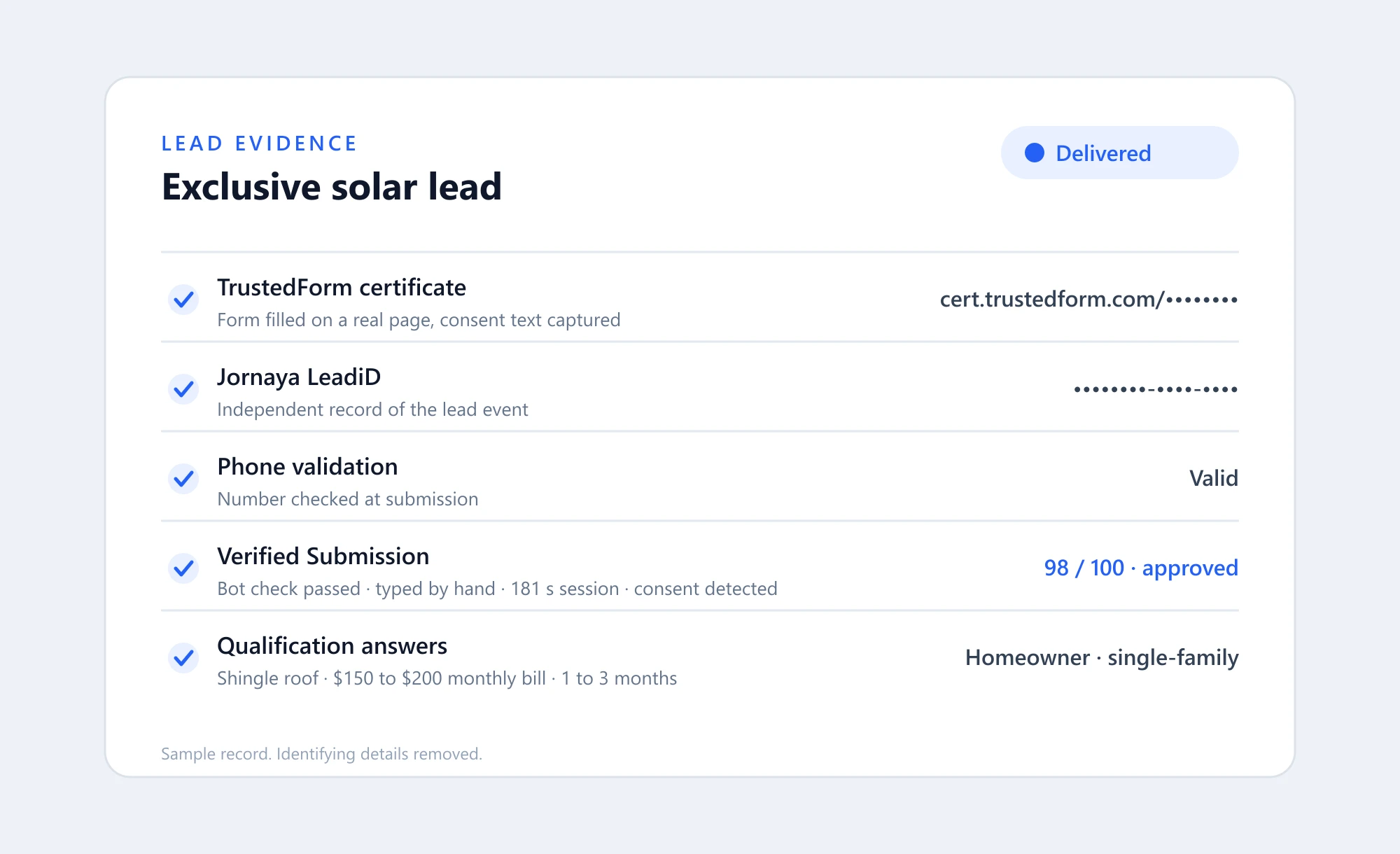
A return rate is only as good as the buyer's ability to check a lead. Leads from our own forms reach the buyer carrying the evidence below, so a disputed lead can be settled against records rather than opinion.
| Field the buyer receives | What it lets the buyer check |
|---|---|
| TrustedForm certificate URL | The consumer filled in the form on a real page, and what consent language they saw |
| Jornaya LeadiD | An independent record of the lead event |
| Phone validation flag | The number was valid when the lead was submitted |
| Verified Submission score (1 to 10) and reason | Our fraud and intent score: bot check result, whether fields were typed by hand, session length, and whether consent was detected |
| Homeowner, property type, utility, monthly bill | The qualification answers the lead was sold on |
The exclusive verified solar leads post explains why we verify before delivery rather than after, and the how to verify solar leads guide walks through checking each field yourself.
Audit a lead's evidence in 10 minutes
- Open any lead from the last week and find its TrustedForm certificate link. Open it and confirm the page, the date and the consent text.
- Check the phone validation result against a call attempt. A disconnected number on a lead marked valid is a return under most terms.
- If a lead arrived with no certificate and no lead ID, ask your seller why. It cannot be audited, so it cannot be fairly disputed either.
- Ask your seller what lead-intelligence screening runs on every lead, and for the score and reason on one of yours. A score with no reason behind it is not evidence.
What these numbers assume
A return rate reflects the return terms behind it. Ours accept returns within seven days for leads outside the buyer's area, disconnected numbers, duplicates, job seekers and contractors, renters, and mobile or manufactured homes. A homeowner who does not answer, is not interested or does not close is not a valid return under our terms, so those leads are not in the numbers. Earlier quarters were reviewed under the terms in force at the time. A seller with looser terms will report a higher rate and a seller with tighter ones a lower rate, which is why the criteria belong next to the number.
The figures also depend on buyers. Some request every return they are entitled to and some never request any. With more than 200 companies buying from us over the two years, individual habits average out, but they do not disappear.
Our pricing page lists prices and return terms side by side, and the exclusive solar leads page explains how leads are generated and routed.
See the evidence on your own leads
Book a demo and we will show you a live lead with its certificate, lead ID and verification score, the return terms that apply to it, and what the last 12 months look like in the states you buy in.
Want leads like the ones in this guide?
Solcertain generates exclusive, verified residential solar leads for one company per territory, delivered in real time.
Want to do this yourself? Join the free Lead Lab, our community for generating your own leads.