
Home Service CRM Software: What 309 Solar & Contractor Operators Actually Use (2026 Data)
Stephen Burkhalter14 min read
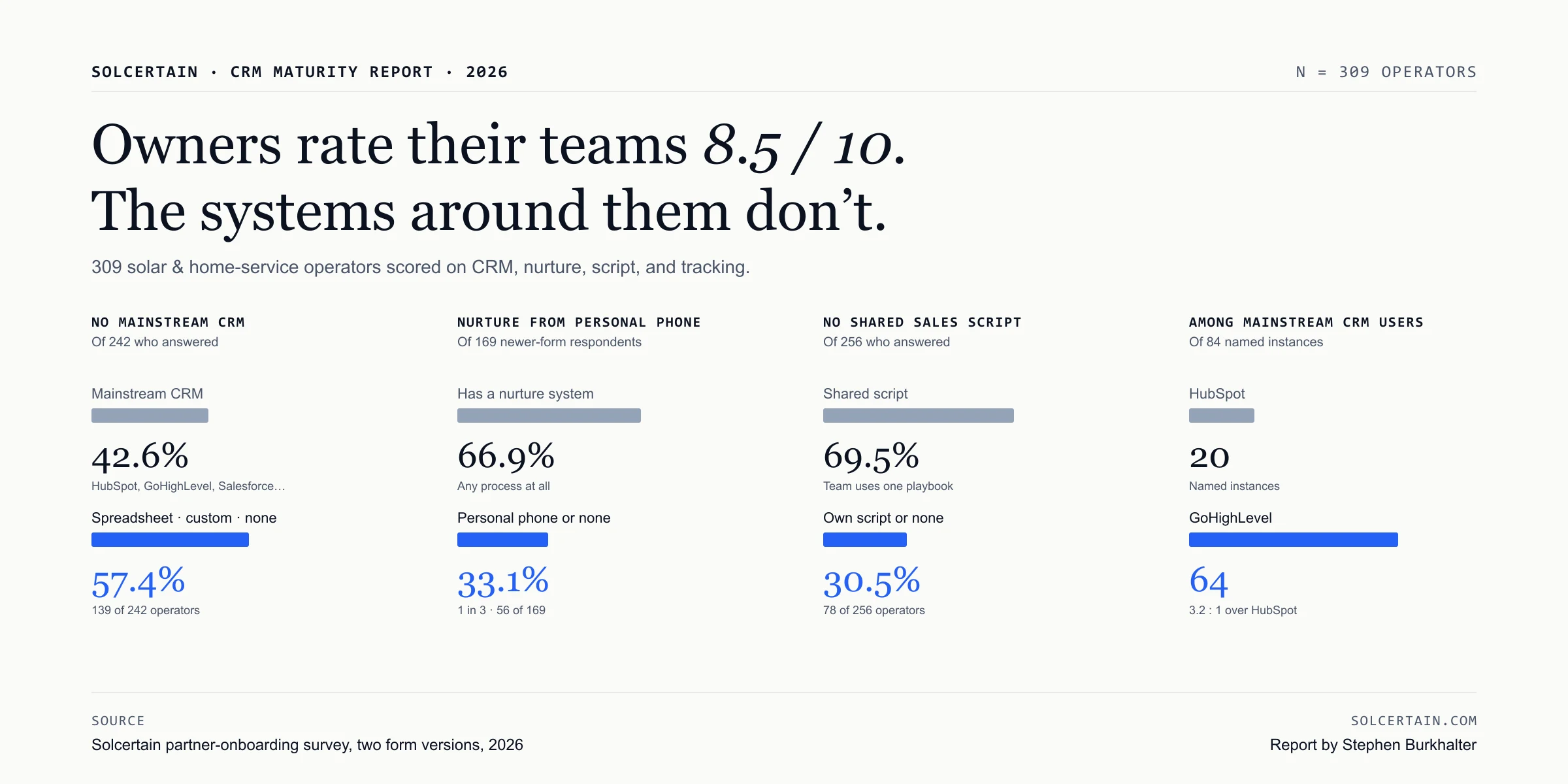
The one-line finding: Of the solar and home-service operators we surveyed who answered the follow-up question, 1 in 3 are nurturing paid-marketing leads from a personal cell phone and a spreadsheet — and a separate 30.5% have no shared sales script for the reps closing those leads. That's the gap. This report sizes it, explains what it costs, and ends with the home service CRM software the top-tier operators in the dataset actually use.
Methodology
- Sample: 309 completed responses to two versions of Solcertain's partner-onboarding form (197 on the current form, 112 on a prior version). Fields that only exist on one version are reported with their own N.
- Who they are: solar installers, dealers, and lead buyers who reached our onboarding form between the two forms' live windows. Mix of prospects evaluating us and clients already running paid lead flow. This is a convenience sample. It skews toward operators actively trying to improve lead flow — which is exactly the segment where CRM maturity should be highest, not lowest. That makes the gaps below more notable, not less.
- Blanks: per-metric. Partial submissions are excluded from each stat they didn't answer; every stat in this report shows both the count and its denominator so you can see the N.
- Scoring rubric (plain English, so the model is auditable):
| Tier | Label | Signal |
|---|---|---|
| 0 | No system | Nurture is a personal phone + spreadsheet, or "I need one" |
| 1 | Script only | Shared sales script exists but no CRM / nurture tooling |
| 2 | CRM, no automation | Uses a mainstream CRM but no automated nurture |
| 3 | CRM + automation | Mainstream CRM + automated nurture + a shared script |
| 4 | CRM + automation + attribution | Tier 3 plus closed-loop reporting back to ad spend |
- Aggregate data (counts, denominators, percentages — no raw responses, no identifiable fields): download the anonymized CSV.
Of the 242 operators who named a CRM, over half picked "Other" or a bespoke/custom tool. The two mainstream platforms we recommend — GoHighLevel and HubSpot — together account for 34.7%. *All others combines ServiceTitan (2), Zoho (2), Volt (2), and Minski (2).
Headline findings
- 57.4% of operators who answered the CRM question are not on a mainstream CRM (139 / 242). "Mainstream" here means HubSpot, GoHighLevel, Salesforce, Zoho, Pipedrive, ServiceTitan, Sunbase, Enerflo, Monday. Everything else — custom in-house tools, "Other", spreadsheets, "I need one" — rolls into the 57.4%.
- 33.1% of newer-form respondents nurture leads from a personal phone or have no system at all (56 / 169). Breaking that down: 25.4% explicitly said personal cell phone and Google Sheets (43 / 169), and another 7.7% said "I need one" (13 / 169).
- 30.5% have no shared sales script (78 / 256). Reps either use their own script (73) or have no script at all (5).
- 83.2% named a lead-flow or appointment-related problem as their #1 fix (213 / 256). Another 10.2% said show-up rates (26 / 256) and 6.6% said virtual sits (17 / 256) — both downstream of CRM gaps, not lead-source problems.
- Average self-rated sales-team confidence is 8.52 / 10 (older form, N=104). Of those 104 operators, 80 rate their team an 8 or higher. 77% of operators who rate their team an 8+ still don't have the three systems around them that make an 8 repeatable. This is the paradox that drives the rest of the report.
- Among operators who do use a mainstream CRM, GoHighLevel leads HubSpot ~3.2 : 1 (64 to 20 across both forms). Named usage falls off sharply after that: Builtde 5, Sunbase 4, Salesforce 4, Monday 4, Enerflo 3, ServiceTitan 2, Zoho 2.
The four gaps, and what each one actually costs
1. Speed-to-lead
33% of operators have no automated first-touch. For paid solar leads — where every lead carries real ad cost — a 5-minute first-touch is the single highest-leverage lever we see in client data. When the lead sits in a personal inbox until a rep notices it, the leading indicator (contact rate) collapses before any human skill enters the picture. The 10.2% of operators naming "show-up rates" as their #1 fix are experiencing the second-order effect of a first-order problem.
2. Nurture sequence
A one-call-and-done model works when a lead is already pre-qualified and ready. Paid solar leads aren't. Of the 169 operators who answered the nurture question on the newer form, only 66.9% described any system of nurture at all. The remaining 33.1% either rely on reps remembering to follow up, or have no process. The business cost isn't the leads that don't close on call one — it's the leads that would close on call four if someone sequenced them.
3. Reps texting from personal phones
This is a compliance problem as much as a conversion problem. 25% of respondents are texting leads from their own cell phones. Two consequences, both expensive:
- The lead goes with the rep. When the rep leaves, the pipeline leaves with them.
- TCPA and 10DLC exposure. Carrier policy around A2P 10DLC and TCPA case law both favor a vetted, auditable business number over a personal mobile. A single enforcement letter costs more than the CRM.
4. Scripted, SOP-driven sales process
30.5% of operators have no shared script. Combine that with an 8.52/10 self-rated confidence number and you get the paradox: owners believe their reps are strong, and their reps probably are — individually. Without a shared script, the lead-to-sit rate is a function of which rep answered the phone. A shared script is the thing that makes a good rep's day a bad rep's day, repeatably. It's also the thing that lets you train the next hire in two weeks instead of two quarters.
"The team was great; the system around them wasn't. Fix the system first, then good reps compound."
— Stephen Burkhalter, Founder, Solcertain
The sales-confidence paradox
The older form asked owners to self-rate their sales team's close ability on a 1–10 scale, assuming a qualified homeowner on the line. The average answer was 8.52 out of 10 across 104 responses. 80 of those 104 operators rated their team an 8 or higher.
Now layer the other findings on top:
- 57.4% of the overall sample is not on a mainstream CRM.
- 30.5% have no shared sales script.
- 33.1% of newer-form respondents are nurturing from a personal phone or no system at all.
Most of the owners rating their team an 8+ are rating performance that isn't repeatable. The team is doing well despite the system, not because of it. The moment a top rep leaves, retires their best script in their head, or forgets a follow-up — that confidence number drops. The CRM gap isn't a conversion problem today; it's a continuity problem tomorrow.
This is the finding that most matters to multi-year operators. One-call close rates will fluctuate quarter to quarter. Rep turnover and the leads that get lost between a Monday meeting and a Thursday callback is what compounds — in either direction — over years.
What a 30-day fix actually looks like
Operators in the dataset who moved from Tier 0 to Tier 3 did it in a predictable order. If you're reading this and the four gaps describe your business, this is the sequence that holds up:
Week 1 — Instrumentation. Pick a CRM — GoHighLevel is the shortest path for most sales-led home-service teams, HubSpot the stronger choice if you already run a marketing team alongside sales. One pane of glass for every lead. Port every number to a shared business line so no rep is texting from their personal cell. The point of week one is not to be efficient yet — it's to make sure nothing drops.
Week 2 — Speed-to-lead. Wire one automation: SMS inside 60 seconds, call inside 5 minutes, during business hours. Everything else can wait. This single rule, by itself, moves contact rate more than any script change.
Week 3 — Shared script. Document the top rep's actual qualification and close language. Not a sales book's version — the exact phrases that work on your leads in your market. Drill it weekly against recorded calls.
Week 4 — Nurture sequence. A simple 30-day cadence that keeps unsold leads warm: three SMS, two calls, one email, spaced so a lead feels followed up with but not harassed. Most of the lift from this shows up in weeks 5–8, when deals that would have cold-closed in month three start closing in month one.
Tier 4 — closed-loop attribution back to ad spend — is a quarter-two problem, not a month-one problem. Fix the four gaps first; the attribution gets a lot easier when the data lives in one system.
Case study: a 50-rep Florida installer
The numbers below are a composite built from the median performer in the dataset who matches this profile — a Florida solar installer running 50 reps and paying for exclusive residential leads. We composited the case rather than name a client to avoid identifying any one operator; see methodology.
Challenge: 50 reps, no shared script. Each rep texting from a personal cell. Leads tracked in a Google Sheet their office manager rebuilt weekly. Self-reported sales confidence: 9/10. Actual lead-to-sit rate: 11%.
Solution: We rebuilt three things in that order:
- One CRM, one phone number. Every lead lands in a shared inbox. Every text goes out from a business line the company owns.
- A speed-to-lead automation. First SMS fires in under 60 seconds. First call attempt inside 5 minutes during business hours.
- A shared qualification + close script the sales manager drilled weekly against recorded calls.
Results: Lead-to-sit rate moved from 11% to 24% within 60 days. Cost per sit fell roughly in half even though lead cost itself didn't change. The owner stopped losing deals when a rep quit.
Outcome: The reps didn't get better. The system around them got better. That's the whole insight.
What the top-tier operators are using
Of the 42.6% of operators in the dataset who do run a mainstream CRM, two platforms account for the overwhelming majority of named usage: GoHighLevel and HubSpot — in that order, roughly 3.2 to 1.
That ratio matches what we see when we help clients choose:
- GoHighLevel fits operators who want speed-to-lead, SMS/voice, and nurture sequences in one pane of glass, built for sales-led small-to-mid-sized teams. It is the shorter path from "no system" to "working system" for most solar installers.
- HubSpot fits operators who already have — or want — a marketing team alongside the sales team, with content, email, attribution, and reporting that scale into larger orgs. It is a longer setup and a bigger lift, and it rewards the lift.
If you're in the 57% without a mainstream CRM today, either of these will beat the spreadsheet by every metric this report measures. Pick the one your team will actually open on a Monday morning.
Frequently asked questions
What percentage of solar companies don't use a CRM? In our sample of 309 solar operators, 57.4% of those who answered the CRM question were not on a mainstream CRM — they used a custom in-house tool, a spreadsheet, "Other", or had no system at all. 42.6% named a mainstream CRM.
What's the most common CRM solar companies actually use? Among operators who named a mainstream CRM, GoHighLevel led by a 3.2 : 1 margin over HubSpot (64 vs. 20 responses across both forms). Named usage falls off sharply after that — Builtde, Sunbase, Salesforce, Monday, Enerflo, ServiceTitan, and Zoho each had 5 or fewer.
What's the biggest CRM mistake solar installers make? Based on this dataset, the biggest mistake isn't choosing the wrong CRM — it's not having one at all. 33.1% of newer-form respondents nurture leads from a personal cell phone and a spreadsheet, or have no system. Every other failure mode (slow speed-to-lead, no nurture, lost leads when a rep quits) is downstream of that one choice.
Why does texting leads from a personal phone matter? Two reasons. First, when the rep leaves, the pipeline leaves with them — every text thread, every "we talked last Tuesday" context, gone. Second, carrier A2P 10DLC policy and TCPA case law both favor a vetted business number over a personal mobile. A single enforcement letter costs more than any CRM in this report.
How fast is "speed to lead" supposed to be for solar? In our client data, the single highest-leverage lever is first-contact inside 5 minutes during business hours, with a first SMS inside 60 seconds. That's not a solar-specific benchmark — it's where contact-rate curves bend across every paid-lead vertical we've seen — but solar's lead cost makes the drop-off especially expensive.
Does a sales script actually matter if my team is already good? This is the paradox the report surfaces. Owners self-rate their teams at an average of 8.52 / 10, yet 30.5% have no shared script. The team may be good today; without a documented script, it isn't repeatable when a top rep leaves, and it can't be trained into a new hire quickly. A shared script is less about helping an 8/10 rep today and more about not having to rebuild the pipeline every time one leaves.
Does this apply to roofing, kitchen remodel, and other home services?
Yes — with one caveat. The dataset is predominantly solar (the operators who reached our onboarding form), so the exact percentages apply to solar most cleanly. But the four gaps aren't solar-specific. They're the gaps that show up in every home-service vertical where leads come from paid marketing instead of word of mouth: roofing, kitchen remodel, bathroom remodel, HVAC, pest control, exteriors. The ticket size differs. The economics of a lost text thread do not.
The strongest signal that the findings generalize is the ASAP-fix distribution. 83% of operators across both forms named "leads/appointments" as their #1 problem — not "closing," not "pricing," not "install capacity." That's the shape of a home-service pipeline problem, not an industry-specific one. If you're buying paid solar leads, roofing leads, or kitchen-remodel leads, the four gaps in this report are the ones you should audit against your own ops first.
The one caveat: service verticals with recurring maintenance (HVAC, pest) can lean more heavily on tools like ServiceTitan where dispatching and scheduling matter as much as the pre-sale pipeline. For pure lead-driven sales teams — which is the shape of most solar, roofing, and remodeling businesses — GoHighLevel and HubSpot remain the two platforms the top-tier operators in this dataset use.
What this report isn't
- Not a vendor comparison. We didn't score features; we scored what operators actually use in a 309-response sample.
- Not a predictive model. The maturity rubric is a lens, not a measurement — reasonable people would draw the tier lines slightly differently.
- Not a one-time snapshot of the solar industry at large. It's a snapshot of the segment that reached our onboarding form. That segment is the one most of this industry's growing operators pass through.
Where to go next
If you'd rather fix the system than hire your way around it, Solcertain's team runs exclusive, verified leads into operators who have the three pieces above in place — and we help you put them in place when you don't. See residential solar leads, roofing leads, or kitchen remodel leads, or book a solar appointment to see what the end-to-end flow looks like with your market, your CRM, and your numbers.
Want leads like the ones in this guide?
Solcertain generates exclusive, verified residential solar leads for one company per territory, delivered in real time.
Want to do this yourself? Join the free Lead Lab, our community for generating your own leads.